

You don't need a greenfield budget to get a modern control system. A phased upgrade of PLCs, HMIs, drives, and networks can remove most of the risk of an aging plant for a fraction of the cost and downtime of a full replacement.
That matters right now. Modern Materials Handling's 2026 Outlook Survey found many manufacturers and distributors pacing near-term automation spending, even as longer-term confidence grows. Capital committees want smaller, surer bets. Meanwhile, the controls running your conveyors, palletizers, process skids, and packaging lines keep getting older.
For directors of engineering and the automation and process engineers who work for them, the question is no longer whether to modernize. It is how to do it without stopping production or waiting for a budget that may not come.
The real cost of standing still
A control system that still runs is not the same as one that is safe to depend on. The risk builds quietly in four places.
Obsolete hardware. Several widely installed PLC families are discontinued or in phase-out. Spare CPUs and I/O cards get harder to find, and surplus-market parts arrive with unknown history and inflated prices.
Single points of failure. One failed processor or a corrupted program with no current backup can stop a line for days, not hours.
Shrinking know-how. The engineer who wrote the original logic may have retired. Old programming software may only run on one aging laptop in the maintenance shop.
No visibility. Legacy controls often can't share data with MES, SCADA, or WMS. That leaves you running the floor on clipboards and guesswork while the rest of the business wants real-time numbers.
None of these show up on the P&L until the day the line goes down. That is why a modernization case should be framed around risk avoided, not just features gained.
Assess before you spend
Good modernization starts with a controls audit, not a quote for new hardware. A focused assessment, often only a few days on site, tells you where your risk is and what to fix first.
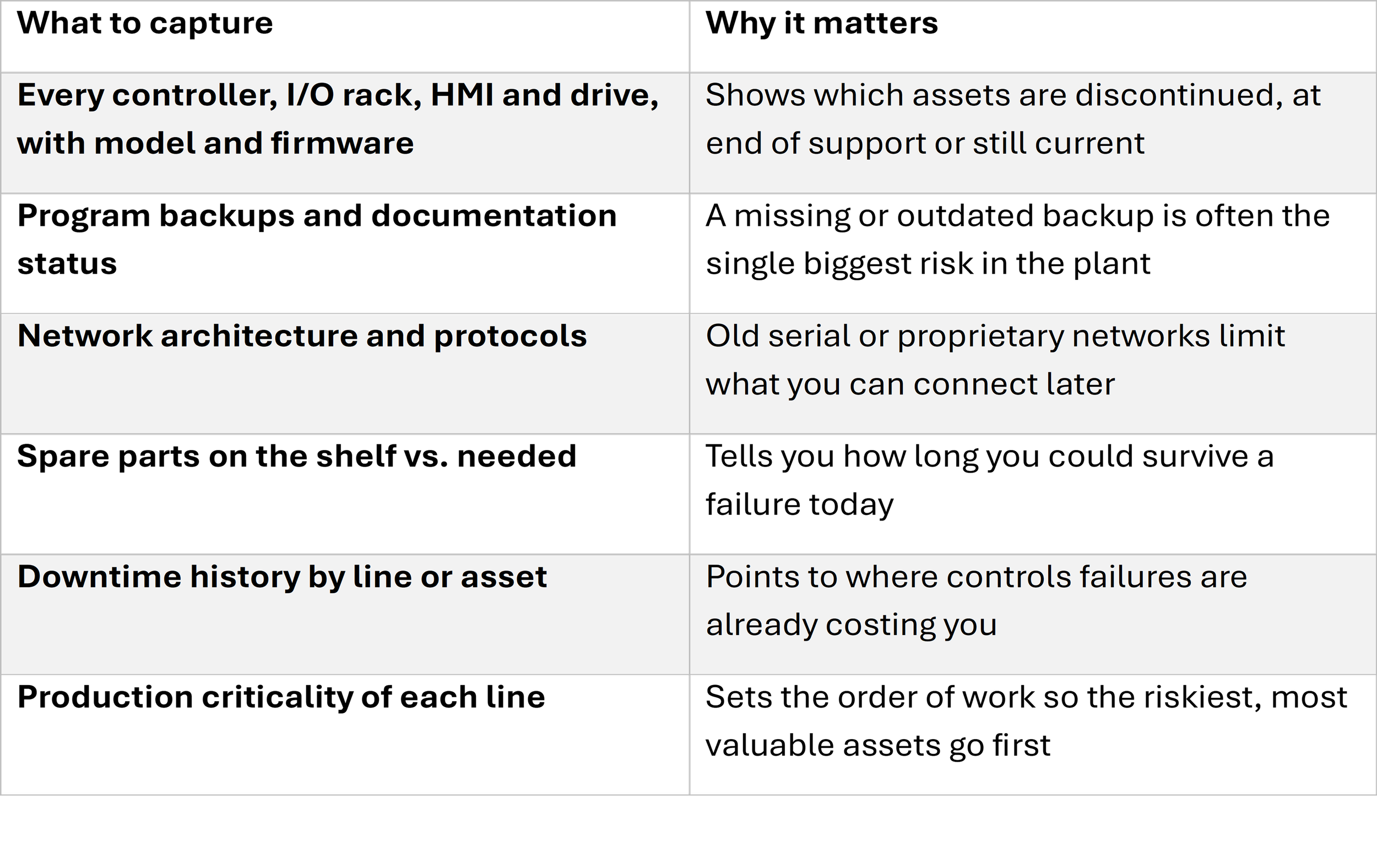
The output should be a ranked list: what to replace now, what to stabilize with spares and backups, and what can wait. That ranking turns a vague "we need to upgrade" into a plan finance can approve one phase at a time.
A phased migration playbook
Modernization works best as a series of contained steps, each one paying off on its own. A typical sequence looks like this:
Stabilize first. Back up every program, document it, and stock critical spares. This costs little and buys time for everything else.
Upgrade the network. Moving from legacy serial or proprietary networks to industrial Ethernet lays the groundwork for every later step and for future SCADA, MES, or WMS connections.
Migrate the processor, keep the I/O. Many platforms offer adapters or conversion kits that let a new controller run existing I/O and field wiring. This avoids rewiring panels and shrinks the outage window.
Convert and improve the logic. Translate the old program, but don't just copy it. Clean up dead code, standardize tag names, and add diagnostics so the next fault is faster to find.
Replace HMIs. Modern operator screens with clear alarms, trends and fault messages cut troubleshooting time and reduce operator error.
Modernize drives. Swapping older drives for current VFDs improves speed control and energy use, and lets drive faults report straight to the HMI.
Retire the old I/O last. Once the new system is proven, replace field I/O on planned shutdowns, line by line.
Each phase is sized to fit a scheduled outage and a single budget line. If funding pauses after step 3, the plant is still in better shape than it was.
Keeping downtime to a minimum
The fear of a long outage stops more upgrades than cost does. Careful cutover planning takes most of that risk off the table.
Test before you touch the floor. Simulate the converted logic and HMI offline, ideally against a model of the machine, so most bugs are found at a desk instead of during startup.
Pre-build panels. Assemble and test new control panels off-site so installation is a swap, not a build.
Use planned shutdowns. Line up each phase with holidays, weekends, or scheduled maintenance windows.
Run in parallel where possible. On some systems, the new controller can monitor live I/O alongside the old one before it takes control.
Keep a rollback plan. Know exactly how to put the old system back if startup runs long. You'll rarely need it, but having it makes approval easier.
Train operators and maintenance before go-live. A new HMI nobody understands can cost more uptime than the old one did.
Building the business case
A phased plan is easier to fund because each step can show its own return. When you take it to leadership, put numbers on these points:
Cost of one unplanned outage. Lost throughput per hour, times realistic recovery time on obsolete hardware.
Spare parts exposure. What critical legacy spares cost today, and how long they take to arrive.
Maintenance hours. Time spent chasing faults that better diagnostics and HMIs would expose in minutes.
Energy savings. Modern VFDs on fans, pumps and conveyors often cut energy use noticeably.
Data value. Connecting to SCADA, MES or WMS opens up OEE tracking, traceability and better scheduling.
Compare the cost of phase one with the cost of a single bad week on that line. In many plants, the first phase pays for itself the first time it prevents a long outage.
Start with a conversation
If your plant runs on controls you're quietly worried about, the first step doesn't have to be a big one. Imperium can help you take stock of what you have, rank the risks, and map out a phased upgrade that fits your production schedule and budget, whether that's a single panel or a full line.
Want a second opinion on your legacy controls? Get in touch with the Imperium team. Expert help is just a call away.
About Imperium
Imperium Technology Solutions is an industrial controls integrator that serves factories and warehouses across the United States. The team takes a nimble, non-traditional approach to integration and brings decades of automation experience to every project. Imperium handles controls engineering, panel design and assembly, PLC, HMI and VFD modernization, and WMS, MES and SCADA integration, along with mechanical and electrical installation. That makes it a one-stop shop from first assessment to commissioning. Its service engineers also support existing systems when production problems come up.
Sources
2026 Outlook Survey: Signs of caution, but automation marches on, Modern Materials Handling